thecreativespace
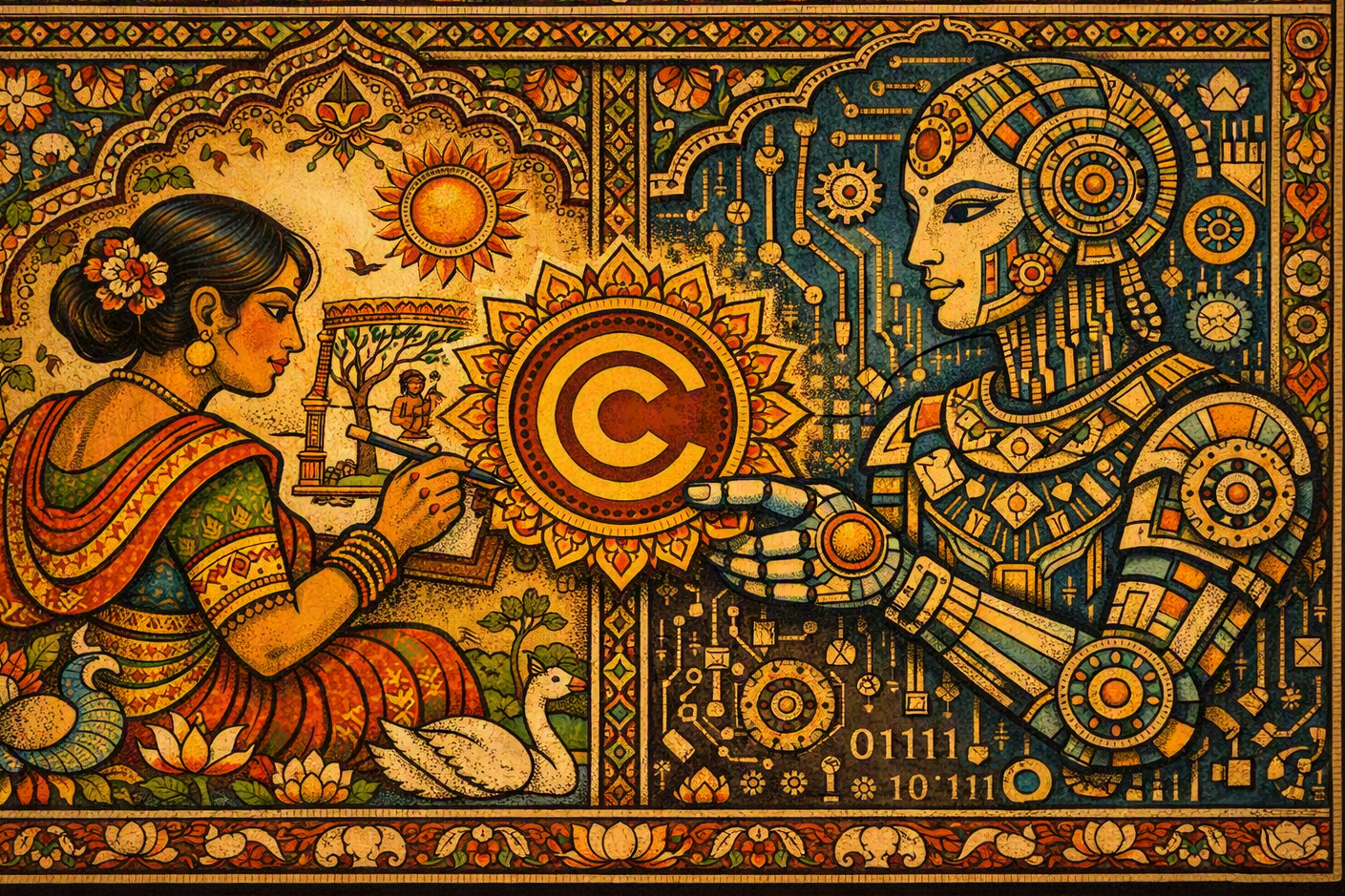
Every technological revolution forces society to rewrite its rules. The printing press transformed publishing. Photography challenged painting. The internet reshaped communication. Today, generative artificial intelligence is compelling us to revisit one of the oldest questions in intellectual property law: “Who owns creativity?”
When Human Art Becomes Machine Fuel
Unlike earlier technological revolutions, however, generative AI does not merely create new tools. It learns from existing human creativity. Generative AI systems today can write essays, compose music, create paintings, and generate images with amazing sophistication. Their outputs often appear strikingly similar to human creative work.
Behind every AI-generated image, every synthetic voice, and every machine-written paragraph lies an invisible archive of human expression -- paintings painstakingly created over months, books written over years, songs shaped by generations of tradition, and photographs that captured moments never to be repeated. As artificial intelligence grows more capable, and as governments across the world begin to rethink copyright in the age of AI, the debate is no longer simply about technology. The focus now is on whether those whose creativity fuels these systems should be recognised, compensated, and protected.
It is perhaps easiest to understand this not through a courtroom or a technology laboratory, but through the story of an artist.
Consider the instance of a traditional Madhubani artist in a small Indian village. Her work may win awards and admiration, yet she may not know how to send a message on WhatsApp or upload her artwork online. Somewhere far away, however, images similar to her creations may already be circulating on the internet, quietly absorbed into datasets used to train artificial intelligence systems. If an AI model learns from such works and later produces similar images, an uncomfortable question arises: who benefits from that creativity -- the machine, the technology company, or the artist whose tradition inspired it?
How AI Is Reshaping Creative and Intellectual Work
Artificial intelligence is rapidly transforming the way we create, communicate, and consume information. AI is a technology disruptor and the disruption is being felt across fields. The world now also feels threatened by AI and is trying to regulate it by bringing in laws. Artificial intelligence can ingest, analyze, and learn from vast quantities of human-created content at a scale no individual could match. It can parse the internet, extract patterns, and generate new outputs based on millions of creative works -- often without the knowledge or consent of the original creators. In the physical world, such unacknowledged use of creative labour would raise serious concerns about fairness and ownership. In the digital world, it has become an invisible norm.
The material AI is fed on originates from copyrighted works created by authors, artists, musicians, and performers. In many cases, these creators are neither informed nor compensated when their works become part of AI training datasets. As artificial intelligence continues to evolve, a growing concern is emerging across the world: the intellectual labour of countless creators may be quietly fuelling a new technological revolution without recognition or reward.
In my monograph, Ramifications of Artificial Intelligence (Dr. Mathew Thomas: Visakhapatnam, 2020), I observed that advances in AI would inevitably force legal systems to confront questions of authorship and intellectual property. What appeared speculative then has become an urgent policy debate today.
A serious concern now is that AI-generated output will create new headaches for authorities. The law recognizes only human creations of the mind and not machine created works.
The Foundations of Copyright and Creative Rights
Copyright law was historically designed to prevent precisely such situations. Its central purpose has always been to protect the creative efforts of individuals by granting them limited rights over their works. These rights provide economic incentives for creativity while ensuring that knowledge eventually enters the public domain for the broader benefit of society. The system seeks to balance two important goals — rewarding creators and encouraging the spread of knowledge.
The Power Imbalance Between Creators and AI Companies
Generative AI places this balance under strain. AI companies possess vast computational resources and legal expertise, while individual creators, especially those outside formal digital ecosystems, may lack the means to monitor or challenge unauthorized use of their work. Even if a creator suspects that their work has been used without permission, pursuing legal remedies can be difficult, expensive, and time-consuming.
The challenge becomes even more complex in countries such as India, where artistic creativity flourishes across both urban and rural communities. India’s cultural landscape includes countless folk artists, storytellers, performers, and traditional craftsmen whose work forms an integral part of the nation’s heritage. Many of these creators may not be digitally literate or familiar with the complexities of intellectual property law.
Policies that rely heavily on digital tools, such as online licensing systems or opt-out mechanisms, may not provide effective protection for them. Without appropriate safeguards, the benefits of AI could increasingly flow to large technology companies while many creators remain unaware that their work has contributed to these systems.
Who Owns AI-Generated Output?
Another important question is regarding the copyright status of works generated by artificial intelligence itself. Traditional copyright law recognizes creations that originate from the human mind. AI-generated outputs, however, are produced through algorithms trained on vast quantities of existing human works. Determining authorship in such cases becomes complicated. Is the author the programmer who designed the algorithm, the engineer who trained the model, the user who provides the prompt, or the company that owns the technology?
The Risks of Granting Copyright to Machine-Generated Works
Granting copyright protection to AI-generated works without careful consideration could create further complications. Artificial intelligence systems can produce an almost limitless number of variations of images, texts, and musical compositions. If each such output were granted copyright protection, the legal system could face an overwhelming proliferation of claims involving machine-generated works.
Innovation Should Not Eclipse Human Creativity
These concerns do not suggest that artificial intelligence should be restricted or discouraged. On the contrary, AI has immense potential to accelerate research, improve productivity, and unlock new forms of creativity. However, technological progress should not come at the expense of the creators whose works make such progress possible.
Toward Fair Compensation and Transparent AI Practices
One possible solution is the development of mandatory licensing frameworks, under which AI developers compensate creators whose works are used in training datasets. Such mechanisms could help ensure that artists, writers, and musicians receive fair remuneration while allowing AI research and innovation to continue.
Equally important is the development of clear transparency and fair-practice standards for AI companies. Greater accountability regarding the collection and use of training data would help build trust between technology developers and the creative community.
Building a Just and Sustainable Creative Future
Artificial intelligence promises extraordinary advances, but its progress must not come at the expense of the human creativity that powers it. If innovation is to remain just and sustainable, policies must ensure that creators are recognized, compensated, and protected. The future of AI should be built not on uncredited human labour, but on a fair partnership between technology and the creative minds that inspire it.
(Dr. Mathew Thomas Is a former services officer with three published monographs, and his fourth book is Art and Its Manifestations (Kairali Books: Kannur, 2026). His poems have been translated into Malayalam and included in a collection Rathriyude Sugandham, also published by Kairali Books in 2025. He has served with an IIM and a NLU both as a teacher and administrator and served as an independent director with a company. He has an avid interest in art and philately.)
(This content is based on the comment on Generative AI and Copyright, which was sent by the author to the DIPP (DPIIT), Ministry of Commerce, Government of India in response to their invitation for comments from the public on 08 December 2025. Edited by Dr. Jayasree Ramakrishnan Nair.)